
min. 99.5% copper oxalate, pure, powder, copper(II) oxalate, CuC2O4, CAS No.: 814-91-5


€104.72
Available, delivery time: 2-5 days
Product information "min. 99.5% copper oxalate, pure, powder, copper(II) oxalate, CuC2O4, CAS No.: 814-91-5"
Copper oxalate (also copper(II) oxalate or cupric oxalate, CAS 814-91-5) is the copper salt of oxalic acid. It occurs as a blue- to bluish-white, odorless powder. Its empirical formula is CuC2O4 (molar mass ≈ 151.56 g·mol-1). The substance has a density of about 6.57 g cm-3 and decomposes on heating at around 300–310 °C, forming copper oxide. Copper oxalate is practically insoluble in water and settles out; however, it dissolves in ammoniacal solution (NH4OH). The salt is largely stable but decomposes explosively when heated and should be kept away from acetylene, ammonia, strong bases, oxidizing agents, and nitromethane.
Applications
Because of its chemical properties, copper oxalate is used primarily as a catalyst for organic reactions and a stabilizer for acetylated polyoxymethylenes. In addition, the salt is employed as a seed dressing to deter birds and rodents. In industry it also serves as a precursor for other copper compounds and—together with ammonia—as a reducing agent. Owing to its high specific copper content and low decomposition temperature, it acts as a colorant in very specialized pyrotechnic compositions.
Chemical and physical properties
- Empirical formula: CuC2O4
- CAS No.: 814-91-5 (anhydrous) or 5893-66-3 (hemihydrate)
- Molar mass: approx. 151.56 g·mol-1
- Appearance: blue- to bluish-white, odorless solid
- Density: approx. 6.57 g cm-3
- Melting/decomposition point: decomposes at about 300–310 °C to copper oxide
- Water solubility: practically insoluble in water; the solubility product Ksp is 4.43 × 10⁻¹⁰; soluble in ammoniacal solution
- Reactivity: dissolves in aqueous ammonia; can act as an acid with bases and as a reducing agent; reacts dangerously with acetylene, strong bases, and oxidizing agents and should not be overheated
SIGNAL WORD: WARNING!
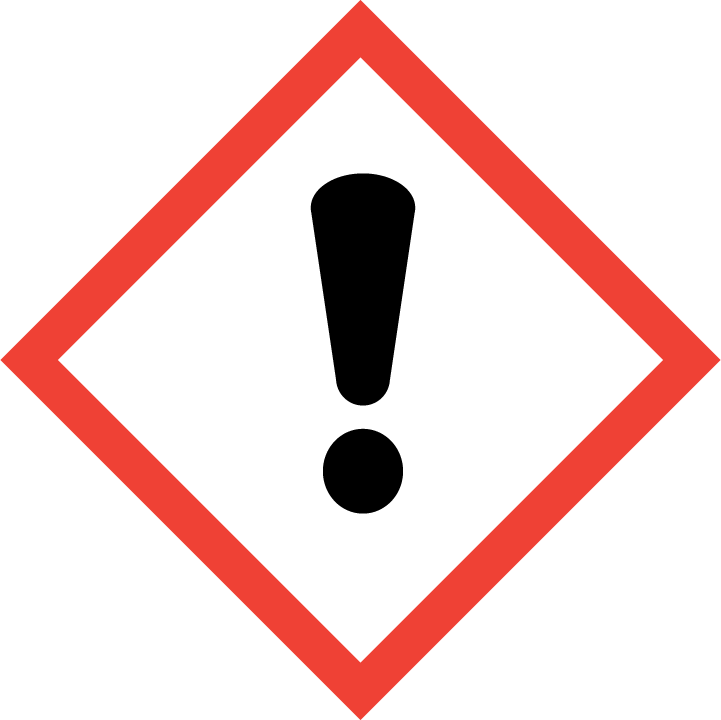
Hazard statements (H-phrases)
- H302: Harmful if swallowed.
- H312: Harmful in contact with skin.
Precautionary statements (P-phrases)
- P280: Wear protective gloves/protective clothing/eye protection/face protection.
- P312: Call a POISON CENTER or doctor if you feel unwell.
- P321: Specific treatment required (see safety data sheet).
- P330: Rinse mouth.
- P360/P362: Immediately take off contaminated clothing and wash before reuse.
- P391: Collect spillage.
- P501: Dispose of contents/container to an approved waste-disposal facility.
| CAS-Nr.: | 814‑91‑5 |
|---|---|
| Color: | Blau |
| Kupfer: | 44,5 % |
| Produktcharakter: | feines Pulver |
| SO4: | max. 0,5 % |
| Stoffgruppe: | Oxalate |
| Trocknungsverlust bei 105° C, 2h: | max. 4,0 % |
| kind of product: | chemical |
| material: | Kupferoxalat |
| zur GPSR-Informationspflicht: | Hersteller + Verantwortliche Person: Werth-Metall, Ringstr. 41b, 99428 Grammetal, info@werth-metall.de |
Login
Passend dazu:

The chemical formula of sodium oxalate is Na2C2O4.This compound is in the form of colorless crystals and is highly soluble in water. Sodium oxalate is mainly used in laboratories and has various applications:Analytical Chemistry: Sodium oxalate is used as an analyte for the determination of calcium and barium ions. With these ions it forms poorly soluble salts that can be used as a detection reaction.Decolorants: Sodium oxalate is used in some decolorants to remove unwanted dyes. It can help eliminate discoloration on textiles, paper or other materials.Cleaning Agents: Because of its ability to complex and remove metal ions, sodium oxalate is used in some cleaning products, particularly for removing rust stains or cleaning metal surfaces.Chemical Reactions: Sodium oxalate can also be used as a reducing agent in some chemical reactions. It reacts with strong oxidizing agents and can itself be oxidized. Signal word: ATTENTION! Danger warningsH302 + H312 Harmful if swallowed or in contact with skinSafety instructionsP264 Wash skin thoroughly after use.P270 Do not eat, drink or smoke when using.P280 Wear protective gloves/protective clothing.P301 + P312 + P330 IF SWALLOWED: Call a POISON CENTER/doctor if you feel unwell. Rinse mouth.P302 + P352 + P312 IF ON SKIN: Wash with plenty of water. If you feel unwell, call a POISON CENTER/doctor.P501 Dispose of contents/container to an approved waste disposal facility.
Content: 0.1 Kilogramm (€47.60 / 1 Kilogramm)

Didymium Today, however, the term is no longer used because the rare earths have been identified and divided into individual elements. Didymium was first discovered in 1841 by the Swedish chemist Carl Gustaf Mosander. He isolated it from cerite, a mineral that is a mixture of rare earths. However, it later turned out that Didymium itself is a mixture of the elements Praseodymium and neodymium. Didymium with its essential components Praseodymium and Neodymium finds a wide range of applications in glass technology and electronics. For example, they are used for the production of Permanent magnets, Lasers / optical fibers, Glasses (special glasses for glassblowers - yellow filters) and Ceramics (glazes) used. It is also occasionally used as a catalyst in pyrotechnics and rocket technology.At high temperatures, the mixed oxalate decomposes into the corresponding oxides. This means that the didymium can easily be further processed in other fields of application. Signal word: ATTENTION! Hazard warningsH302: Harmful if swallowed. H315: Causes skin irritation. H319: Causes serious eye irritation. H335: May cause respiratory irritation.Safety information P261: Avoid breathing dust/fume/gas/mist/vapour/spray. P264: Wash hands thoroughly after use. P270: Do not eat, drink or smoke when using. P280: Wear protective gloves/protective clothing/eye protection/face protection. P301+P312: If swallowed: Call a poison control center/doctor if you feel unwell. P302+P352: In case of contact with skin: Wash with plenty of water/soap. P304+P340: If inhaled: Remove person to fresh air and keep comfortable for breathing. P305+P351+P338: If in eyes: Rinse cautiously with water for several minutes. If possible, remove any contact lenses. Continue rinsing. P337+P313: If eye irritation persists: Get medical advice/attention. Typical chemical composition Name Formula Metal content [wt.%] Content M-oxalate x hydrate [wt.%] Neodymoxalate (Nd(C2O4)3) x 10H2O 25.31 64.28 Praseodymoxalate (Pr(C2O4)3) x 10H2O7.53 19.40 Lanthanum(III) oxalate nonahydrate La2(C2O4)3 x 9 H2O 3.72 9.43 Cerium(III) oxalate nonahydrate Ce2(C2O4)3 x 9 H2O 0.03 0.08 Samarium(III) oxalate decahydrate Sm2(C2O4)3 x 10 H2O 1.99 4.93 Gadolinium oxalate (Gd(C2O4)3) x H2O 0.45 1.09 Europium(III) oxalate decahydrate Eu2(C2O4)3 x 10 H2O 0.01 0.02
Content: 0.1 Kilogramm (€209.60 / 1 Kilogramm)

Typical chemical specifications:FORMULA: SrC2O4APPEARANCE: fine white powderPURITY: min. 98.00%CAS NO.: 814-95-9HCl soluble: max. 0.15%Bulk density: 0.6-0.8 g/cm³Chemical characteristics:Ba: <0.2%Fe: <100 ppmCl-: <500 ppmGranulometry:D90 100 µm (min. 98% < 125µm) Signal word: ATTENTION! Danger warningsH302 + H312 Harmful if swallowed or in contact with skin Safety instructionsP264 Wash skin thoroughly after use.P270 Do not eat, drink or smoke when using.P280 Wear protective gloves/protective clothing.P301 + P312 + P330 IF SWALLOWED: Call a POISON CENTER/doctor if you feel unwell. Rinse mouth.P302 + P352 + P312 IF ON SKIN: Wash with plenty of water. If you feel unwell, call a POISON CENTER/doctor.P501 Dispose of contents/container to an approved waste disposal facility.

Lithium carbonate is used, among other things, in glass production, in the ceramics industry and in metallurgy used. It is used as a melting flux and to increase the melting points of glasses and ceramics. In metallurgy, lithium carbonate is used to produce lithium metal and lithium compounds (lithium hydroxide, also with us available) used. Chemical/physical analysis values (typical) Appearance: White, very dusty powder insoluble. in / insol. in HCL [%]: 0.0001 Ca[%]: 0.01 Cl [%]: 0.01 SO4 [%]: 0.01 H2O [%]: 0.24 Na [%]: 0.05 K [%]: 0.004 Signal word: Attention! Danger information H302 Harmful if swallowed. H319 Causes serious eye irritation. Safety instructions P264 Wash skin thoroughly after use. P270 Do not eat, drink or smoke when using. P280 Wear eye/face protection. P301 + P312 IF SWALLOWED: Call a POISON CENTER/doctor if you feel unwell. P305 + P351 + P338 IF IN EYES: Rinse cautiously with water for several minutes. If possible, remove any contact lenses. Continue rinsing. P337 + P313 If eye irritation persists: Get medical advice/attention.
Content: 0.5 Kilogramm (€109.48 / 1 Kilogramm)

Barium oxalate(C2BaO4) is nextCalcium oxalate, sodium oxalate and strontium oxalatein thepyrotechnics, or in theanalytical chemistryused as a reagent. Occasionally it also finds special applications in metal processing or glass processing.Density: 2.66Melting point: 400°CCAS No.: 516-02-09Purity: min. 98.0%Signal word:DANGER! Danger warnings: H302 + H312 Harmful if swallowed or in contact with skin. H332 Harmful if inhaled. Security measures: P264 Wash skin thoroughly after use. P270 Do not eat, drink or smoke when using. P280 Wear protective gloves/protective clothing. P301 + P312 + P330 IF SWALLOWED: Call a POISON CENTER/doctor if you feel unwell. Rinse mouth.P302 + P352 + P312 IF ON SKIN: Wash with plenty of water. If you feel unwell, call a POISON CENTER/doctor. P304+P340: If inhaled: Remove person to fresh air and keep comfortable for breathing. P501 Dispose of contents/container to an approved waste disposal facility.
Content: 0.05 Kilogramm (€180.00 / 1 Kilogramm)
Calcium oxalate is a crystalline solid, which is slightly soluble in water. In addition to its use in pyrotechnics, the material is primarily used in laboratory analysis, ceramics or metal processing. Kidney stones form from calcium oxalate when high concentrations of calcium and oxalic acid are present in the urine. It can also be found in other parts of the body such as the urinary bladder, ureters, and even the lungs.Typical chemical specifications: Formula: CaC2O4 CAS number: 5794-28-5 Purity: min. 99.5% Fe: 10 ppm Cr: 5 ppm Cu: 1 ppm K: 40 ppm Ni: 6 ppm Zn: 40 ppm Volatile components: 0.3% Signal word: ATTENTION! Danger information H302 + H312 Harmful if swallowed or in contact with skin Safety instructions P264 Wash skin thoroughly after use. P270 Do not eat, drink or smoke when using. P280 Wear protective gloves/protective clothing. P301 + P312 + P330 IF SWALLOWED: Call a POISON CENTER/doctor if you feel unwell. Rinse mouth. P302 + P352 + P312 IF ON SKIN: Wash with plenty of water. If you feel unwell, call a POISON CENTER/doctor. P501 Take contents/container to an approved waste disposal facility.
Content: 0.1 Kilogramm (€34.50 / 1 Kilogramm)