
min. 98.5% barium sulfate, precipitated, Blanc Fixe, barium sulfate, BaSO4, fine powder, 0.7 µm, CAS No.: 7727-43-7
€2.38
Available, delivery time: 2-5 days
Product information "min. 98.5% barium sulfate, precipitated, Blanc Fixe, barium sulfate, BaSO4, fine powder, 0.7 µm, CAS No.: 7727-43-7"
Barium sulfate is also widely used in the paper and paint industry, where it is used as a white pigment, active support of titanium dioxide and to increase the density of paints and varnishes. It is also very frequently used in veterinary medicine .
It is important to note that barium sulfate is high density and is not soluble. Barium sulfate is the only barium salt that is not considered dangerous goods.
Chemical and physical properties
Sieve residue at 45µm: max. 0.007%
BaSO4 content: approx. 98.5%
Water-soluble components: approx. 0.15%
Chloride: max. 0.0009
Volatile components: max. 0.1%
Electrical conductivity: max. 200 µS/cm
Brightness: approx. 99%
pH value: approx. 9
Density: approx. 4.4 g/cm³
Mohs Hardness: 3.5
Specific surface area: 3.0 m²/g
Refractive index: 1.64
Gloss (ISO 2813): very high
Oil number (ISO 787/5): 14 g/100g
| Also known as: | Bariumsulfat, schwefelsaures Barium, Blanc Fixe, gefälltes Bariumsulphat |
|---|---|
| CAS-Nr.: | 7727-43-7 |
| Color: | Weiß |
| Elektrische Leitfähigkeit: | 200 µS/cm |
| Flüchtige Bestandteile (ISO 787/2): | ca. 0,1 % |
| Helligkeit (ISO 7724): | 99,0 % |
| Härte: | 3,5 |
| Produktcharakter: | feines Pulver |
| Si (Silizium): | max. 0,3 % |
| Siebdurchgang: | 20,0 µm |
| Spezifische Oberfläche BET: | 3 m²/g |
| Stampfdichte: | 1,2 kg/dm³ |
| Stoffgruppe: | Sulfate |
| Wasserlösliche Bestandteile: | ca. 0,15 % |
| chloride: | ca. 0,0005 % |
| kind of product: | chemical |
| material: | Bariumsulfat |
| nominal particle size: | d50 0,7 µm |
| ph-Wert: | 9 |
| purity: | min. 98,0 % |
| refractive index: | 1,64 |
| zur GPSR-Informationspflicht: | Hersteller + Verantwortliche Person: Werth-Metall, Ringstr. 41b, 99428 Grammetal, info@werth-metall.de |
| Ölzahl (ISO 787/5): | 14 g/100g |
Login
Passend dazu

This flaky zinc powder is produced from gas-atomized zinc dust. The predominantly spherical zinc dust is milled in protective gas-filled ball mills to achieve the desired particle shape (flaky/flaky/scaly/cornflake). This is a dark and extremely fine zinc powder with correspondingly increased reactivity . Zinc powders are extremely important for modern and sustainable corrosion protection. Both spherical and flaky types are available. However, it turns out that the former types are superior to the latter in several respects: The effect of zinc powder corrosion protection consists of the fact that powder bound in a carrier medium (paint, filler, resins, etc.) creates a barrier effect as well as cathodic protection. Spherical particles, however, initially exhibit predominantly cathodic protection and only a small amount of barrier protection. Platelet-shaped powders, due to their overlapping primary particles, create significantly longer percolation paths and thus immediate barrier protection. Both types, however, possess the same self-healing ability. This is the less magical, but rather purely chemically/physically explainable fact that water penetrating damaged zinc particles causes corrosion. Depending on the environment, this mainly produces zinc oxide, which has a low density and therefore a larger volume. Thus, the damage, unless excessively large, closes itself. However, it can be advantageous to use spherical and platelet-shaped particles together. You can find both in our product range. Should your application involve high mechanical stress, we highly recommend our platelet-shaped stainless steel powder 316L. This, in combination with this zinc powder, represents the ideal choice. Typical Chemical and Physical Specifications CAS No.: 7440-66-6 Average particle size: D50 3.40 µm Sieve residue at 45 µm: max. 0.10% Bulk density: 1.5 g/cm³ Signal word: Danger! Hazard statements: H228: Flammable solidH410: Very toxic to aquatic life with long-lasting effects. Precautionary statements: P210: Keep away from heat, sparks, open flames and hot surfaces. No smoking. P222: Avoid contact with air. P273: Avoid release to the environment. P280: Wear protective gloves/protective clothing/eye protection/face protection.P370+P378: In case of fire: Use sand or special powder to extinguish.

Zinc powder can be produced in various ways. The present product was produced by atomizing molten zinc (air atomization) and is characterized by a low bulk density. Zinc powder is used in a wide variety of applications: for diamond tools, in friction linings, and as a filler in resin systems or special plastics. It is also used as a pigment, chemical reagent, and soldering additive. Typical Chemical and Physical Specifications CAS No.: 7440-66-6 Sieve size: 150 µm Purity: min. 99.7% (Zn) Pb: max. 0.3% Bulk density: 2.95 g/cm³ Particle shape: spherical / irregular Granulometry (ISO 4497) >150 µm: 0.0% >63 µm: max. 15.0% > 45μm: 10-35% Signal word: WARNING! Hazard statements: H410: Very toxic to aquatic life with long-lasting effects. Precautionary statements: P222: Do not allow contact with air. P273: Avoid release to the environment.
Content: 0.5 Kilogramm (€25.70 / 1 Kilogramm)

Stainless steel powder shows higher hardness and abrasion resistance compared to zinc powder pigments . The present platelet-shaped (flaky) powder is oriented lamellarly in several levels in the binder base, with the primary particles always overlapping (non-leafing). This always ensures excellent corrosion protection against rust and UV radiation - even if the substrate is partially worn / scratched. In certain applications it can make sense to add zinc pigment to achieve a better shine. Suitable especially for solvent-based binders. Typical specificationAcetone-soluble components (fats): 0.3 - 0.55% Material: 316L (stainless steel)Particle size distribution (typical values)D90: 62-70 µm D50: 30 - 40 µm D10: 8 - 14.0 µm Signal word: ATTENTION! Danger warnings H317 May cause an allergic skin reaction. H373 May cause damage to organs through prolonged or repeated exposure. H413 May cause long-term harmful effects to aquatic life. Safety instructions P201 Obtain special instructions before use. P260 Do not breathe dust/smoke/gas/mist/vapour/aerosol. P273 Avoid release to the environment. P280 Wear protective gloves/protective clothing/eye protection/face protection. P308 + P313 IF exposed or concerned: Get medical advice/attention. P333 + P313 If skin irritation or rash occurs: Get medical advice/attention.
Content: 0.1 Kilogramm (€73.80 / 1 Kilogramm)
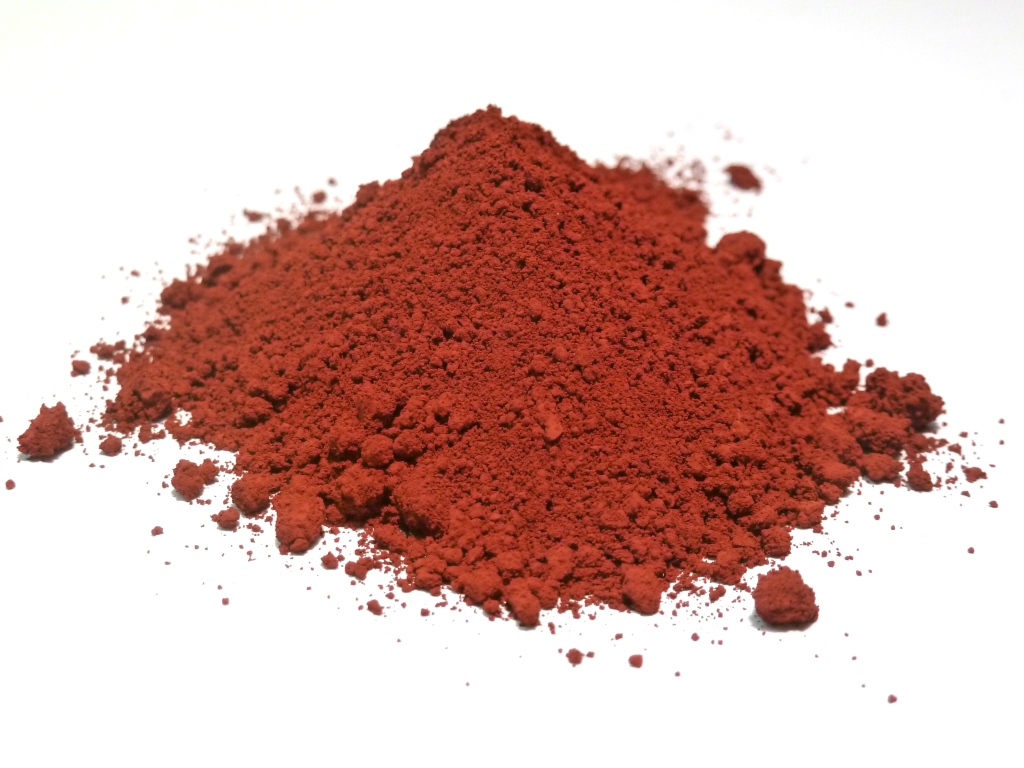
Thisred iron oxideis manufactured synthetically and shows next to onehigh purityoneextremely small primary particle size. Beintense vermilion redcan be ideally used in pigment and ceramic recipes.The use as a catalyst or generally as a chemical reagent is also ideal because of the small particle size.Fe2O3at least 97.50%Water-soluble componentsmax. 0.5%Sieve residue 45µmmax. 0.06%PH valueapprox. 4.5Oil numberapprox. 28g/100gdensityapprox. 5.2 g/cm³conductance500 µS/cm"

This black iron oxide (Fe₃O₄) is a high-quality, synthetically manufactured pigment for all applications requiring high purity and uniform particle distribution. Chemically, it is iron(II,III) oxide, also known as magnetite – that iron oxide modification which, in addition to its intense black coloration, also brings magnetic properties. Thanks to its narrow grain size distribution and constant composition, the pigment is particularly suitable for coatings, paints and varnishes, pigment pastes, construction chemicals, and magnetic materials – everywhere, that is, where reproducible color values and a clean, deep black are required. Constant Quality Through Synthetic Manufacturing Unlike naturally sourced iron oxides, neither the iron content nor the color tone of synthetic Fe₃O₄ fluctuates from batch to batch. The synthetic origin ensures constant quality and reliable performance in different industrial processes – from wet grinding through extrusion to coloring of mineral binders. For processors, this means: less recipe adjustment, lower scrap rates, and plannable color consistency in series production. Even users who only occasionally process smaller quantities benefit from this – the result of the sample can later be reliably reproduced. Fine Particle Size of 300 Nanometers for Optimal Dispersion The low average particle size of 300 nanometers (0.3 µm) is the decisive technical advantage of this iron oxide black pigment. It enables improved dispersion in both liquid and solid formulations, reduces energy input during dispersion, and provides high color strength with relatively low application rates. The result: uniform, streak-free coloring, good coverage, and enhanced efficiency and effectiveness of the end product. Especially in thin-layer systems such as varnishes, glazes, or printing inks, the fine particle size is noticeable through a smooth, homogeneous appearance. Magnetic Properties as a Functional Added Benefit As iron(II,III) oxide, Fe₃O₄ is ferrimagnetic and thus magnetically attractable. This property distinguishes magnetite from other black pigments and opens applications far beyond mere coloring – such as in ferrites, magnetic pigments, toners, or functional coatings, where coloring and magnetic effect are to be combined. Excellent Stability and Color Fastness The pigment additionally impresses with excellent stability and color fastness. It is light- and weather-resistant, alkali-resistant, chemically largely inert, and does not tend to bleed or migrate. This makes it the preferred choice for manufacturers and processors who value durable and high-quality results – such as for facade paints, paving stones and concrete goods, industrial varnishes, or technical plastic parts. Typical Applications at a Glance Paints, varnishes and coatings (solvent- and water-based) Construction chemicals and concrete goods: concrete, screed, mortar, plaster, paving stones, roof tiles Pigment pastes, inks and printing inks Plastics and elastomers (masterbatch, compounds) Magnetic materials and functional materials (ferrites, toner, magnetic pigments) Ceramics, glazes and engobes Handicrafts, restoration and artist supplies: lime and silicate paints, swamp lime, clay plasters Creative and DIY projects: terrazzo, concrete lights, planters, epoxy resin objects FAQ – Frequently Asked Questions About Black Iron Oxide (Fe3O4) For Private Customers and DIY Enthusiasts What can I use black iron oxide for privately? The pigment is very frequently used for coloring concrete, screed, mortar, joint compound, lime and silicate paints, as well as clay and lime plasters. It is also popular for creative projects such as terrazzo, concrete lights, planters, or epoxy resin objects. Iron oxide black is also valued in restoration and artist supplies because it is very color-stable. What does Fe3O4 mean – is that the same as regular iron oxide? Fe3O4 is iron(II,III) oxide, also called magnetite. It is the black variant of iron oxides. Red pigments, on the other hand, consist of Fe2O3, yellow ones of iron oxide hydroxide. All belong to the same pigment family and can be mixed well with each other. How much pigment do I need to color concrete black? As a guide, 1–5% pigment by weight of cement is typical. From about 5%, color saturation is usually reached; higher dosages bring little additional color depth and can impair strength. For a deep anthracite to black, 3–5% is typical depending on cement color. Recommendation: always make a small sample plate, as the color tone appears significantly lighter after drying. How do I mix in the pigment correctly? Best to pre-disperse the powder in some mixing water before processing or thoroughly premix it with the dry binder. This prevents pigment nests and streaks. Extend mixing time slightly compared to uncolored material. Is the color tone weatherproof – or does it fade in outdoor areas? Iron oxide pigments are considered very light- and weather-resistant as well as lime-fast. Lightening in outdoor areas is usually not due to pigment degradation, but to lime efflorescence on the concrete surface. Can I use it to color epoxy resin or wall paint? Yes. The pigment is fundamentally suitable for epoxy resins and dispersion paints and, thanks to its fine particle size, can be easily stirred in. With resins, sparing dosage is recommended, as over-pigmentation can affect curing. Is black iron oxide magnetic? Yes. Fe3O4 (magnetite) is ferrimagnetic and is attracted by a magnet. Precisely this property makes it interesting for magnetic materials. In practice, it plays no disruptive role for coloring concrete or paints. How should I store the pigment? Dry, cool, and tightly sealed. Moisture leads to lumping; the pigment is usually still usable afterward, but should be ground up or sieved before use. Is handling a health concern? Iron oxide pigments are considered toxicologically non-critical. Since it is a fine powder, dust formation should still be avoided and a dust mask, gloves, and safety glasses should be worn. Please always consult the current safety data sheet. Does the pigment rub off once it has dried? In a cured binder, the pigment is firmly bound and does not bleed out. As loose powder, however, it colors strongly – protect work surfaces, tools, and clothing accordingly. Are there also small quantities for private use? Yes, we offer both small quantities for individual projects and larger containers for regular use. The available options can be found directly in the product selection. For Business and Industrial Customers What parameters does the technical data sheet contain? Fe3O4 content, average particle size (D50), bulk density, oil absorption, pH value, moisture content, water-soluble components and residual sieve residue, as well as color values (L*a*b*) and relative color strength against standard. Technical data sheet and safety data sheet are provided upon request. Can we obtain samples for our own recipe development? You can order small quantities starting from 100g in the shop for your development. How does the pigment behave during dispersion? Thanks to the average particle size of 0.3 µm and narrow distribution, the dispersion effort is minimal. For lacquer systems, pearl mills or dissolvers with suitable wetting and dispersing additivation are recommended; the target fineness of grind is usually achieved quickly. Is the pigment temperature and chemical resistant? Fe3O4 is alkali-resistant and stable in common processing procedures. At higher temperatures and oxygen exposure, oxidation to Fe2O3 can begin, leading to a brownish-red color shift. The specific temperature limit should therefore be checked in the respective process window. For high-temperature applications, we are happy to advise on alternatives. Is the product suitable for plastic coloring and masterbatches? Yes, particularly for polyolefins and technical thermoplastics within their respective processing temperatures. Please check the thermal load capacity in your specific process. Can the pigment be used for magnetic applications? Fe₃O₄ is ferrimagnetic and is used, among other things, in ferrites, magnetic pigments, toners, and functional coatings. Whether the magnetic parameters are sufficient for your application, we will be happy to clarify as part of a sample delivery. Is the pigment suitable for cosmetic, food, or pharmaceutical applications? This is a technical grade product. For applications with special purity requirements, please contact us specifically – suitability must be clarified in advance. How long is the product shelf-life? With dry, sealed storage, iron oxide pigment has very long storage stability. The key is protection from moisture; lumped material can usually be reprocessed by grinding or sieving. What terms apply for larger quantities? We ship stock items quickly. For larger purchase quantities, supply contracts, and call-off quotas, we prepare individual offers – please contact our sales team.

Typical chemical specifications:FORMULA: SrC2O4APPEARANCE: fine white powderPURITY: min. 98.00%CAS NO.: 814-95-9HCl soluble: max. 0.15%Bulk density: 0.6-0.8 g/cm³Chemical characteristics:Ba: <0.2%Fe: <100 ppmCl-: <500 ppmGranulometry:D90 100 µm (min. 98% < 125µm) Signal word: ATTENTION! Danger warningsH302 + H312 Harmful if swallowed or in contact with skin Safety instructionsP264 Wash skin thoroughly after use.P270 Do not eat, drink or smoke when using.P280 Wear protective gloves/protective clothing.P301 + P312 + P330 IF SWALLOWED: Call a POISON CENTER/doctor if you feel unwell. Rinse mouth.P302 + P352 + P312 IF ON SKIN: Wash with plenty of water. If you feel unwell, call a POISON CENTER/doctor.P501 Dispose of contents/container to an approved waste disposal facility.

Barium sulfate is an important material in various industries. It is often used as an X-ray contrast agent in medical imaging and also has applications in the oil and gas industry, where it is used in the production of drilling fluids and as filler is used in plastics and rubber. Barium sulfate is also widely used in the paper and paint industry, where it is used as a white pigment, active support of titanium dioxide and to increase the density of paints and varnishes. It is also very frequently used in veterinary medicine . It is important to note that barium sulfate is high density and is not soluble. Barium sulfate is the only barium salt that is not considered dangerous goods.This barium sulfate is extracted directly from the mineral. For this purpose it is purified, dried and ground several times. This means that the material has a very low and therefore machine-friendly quartz content (reduced wear) and high brightness. Chemical and physical properties Average particle size: approx. 1.3µm Top cut: approx. 4µm Sieve residue at 20µm: max. 0.05% BaSO4 content: approx. 98.0% Si content: approx. 0.3% Electrical conductivity: max. 100 µS/cm Brightness: approx. 90 Ry pH value: approx. 8 Density: approx. 4.4 g/cm³ Mohs Hardness: 3-4

Calcium oxalate is a crystalline solid, which is slightly soluble in water. In addition to its use in pyrotechnics, the material is primarily used in laboratory analysis, ceramics or metal processing. Kidney stones form from calcium oxalate when high concentrations of calcium and oxalic acid are present in the urine. It can also be found in other parts of the body such as the urinary bladder, ureters, and even the lungs.Typical chemical specifications: Formula: CaC2O4 CAS number: 5794-28-5 Purity: min. 99.5% Fe: 10 ppm Cr: 5 ppm Cu: 1 ppm K: 40 ppm Ni: 6 ppm Zn: 40 ppm Volatile components: 0.3% Signal word: ATTENTION! Danger information H302 + H312 Harmful if swallowed or in contact with skin Safety instructions P264 Wash skin thoroughly after use. P270 Do not eat, drink or smoke when using. P280 Wear protective gloves/protective clothing. P301 + P312 + P330 IF SWALLOWED: Call a POISON CENTER/doctor if you feel unwell. Rinse mouth. P302 + P352 + P312 IF ON SKIN: Wash with plenty of water. If you feel unwell, call a POISON CENTER/doctor. P501 Take contents/container to an approved waste disposal facility.

Cerium(IV)oxide belongs to the group of rare earths, whose deposits are mainly found in Asia. The material we sell is of high purity and has a cream-white-yellow color (quality feature). Application: Polishing and abrasives, chemical. Catalyst, lamps, laboratory and much more. Chemical analysisFormula: CeO2 CAS No.: 1306-38-3 Content (TREO, GOSE): 99.94% Particle size distribution: d50 8.76µm (BET 88.3m²/g) Ignition loss: 2.0% Na2O: 15 ppm CaO: 46 ppm Cl: 100 ppm La2O3: max. 0.1% Pr6O11: max. 0.1% Nd2O3: max. 0.1%

Producing pure calcium carbonate requires specialized equipment and knowledge to ensure the final product is of the highest quality. The process includes the crushing of calcium carbonate rock, the removal of impurities and the fine grinding of the pure calcium carbonate powder. This process ensures that the calcium carbonate has the correct properties for the specific application and can be used in many different industries. Pure It is also used as a raw material for the production of burnt lime, cement and other building materials, and in agriculture as a soil improver. Specificationscolor shade L: 71.0-77.0 color shade a: -2.5 to +0.7 hue hue b: 9.0-15.0Loss on drying (200°C, 4h): max. 2.0%Acid-insoluble components: max. 0.2 %
The chemical formula of sodium oxalate is Na2C2O4.This compound is in the form of colorless crystals and is highly soluble in water. Sodium oxalate is mainly used in laboratories and has various applications:Analytical Chemistry: Sodium oxalate is used as an analyte for the determination of calcium and barium ions. With these ions it forms poorly soluble salts that can be used as a detection reaction.Decolorants: Sodium oxalate is used in some decolorants to remove unwanted dyes. It can help eliminate discoloration on textiles, paper or other materials.Cleaning Agents: Because of its ability to complex and remove metal ions, sodium oxalate is used in some cleaning products, particularly for removing rust stains or cleaning metal surfaces.Chemical Reactions: Sodium oxalate can also be used as a reducing agent in some chemical reactions. It reacts with strong oxidizing agents and can itself be oxidized. Signal word: ATTENTION! Danger warningsH302 + H312 Harmful if swallowed or in contact with skinSafety instructionsP264 Wash skin thoroughly after use.P270 Do not eat, drink or smoke when using.P280 Wear protective gloves/protective clothing.P301 + P312 + P330 IF SWALLOWED: Call a POISON CENTER/doctor if you feel unwell. Rinse mouth.P302 + P352 + P312 IF ON SKIN: Wash with plenty of water. If you feel unwell, call a POISON CENTER/doctor.P501 Dispose of contents/container to an approved waste disposal facility.

Calcium sulfate dihydrate (CAS number: 10101-41-4) is a compound of calcium, sulfur and oxygen, also known as gypsum. The chemical formula is CaSO4 * 2H2O. Formula: CaSO4*2H2O CAS No.: 10101-41-4 Purity: min. 99.10 % CaO: 37.60% SO3-: 53.7% CO2: 0.8 % Whiteness: 89 Particle size distribution Screen passage /Result 63µm sieve > 99.0% 50µm sieve > 92.0% 40µm sieve > 87.0% 20µm sieve > 70.0%

Formula: C4H6CaO * nH2O CAS number: 114460-21-8 Purity: min. 98.0%-> very fine, dusty powder Signal word: ATTENTION! Hazard information H315 Causes skin irritation. H317 May cause an allergic skin reaction. H319 Causes serious eye irritation Safety instructions P261 Avoid breathing dust/fume/gas/mist/vapour/aerosol. P305+351 If in eyes: Rinse cautiously with water for several minutes.

Our naturally obtained magnetite is a fine, black powder that is obtained from the natural rock magnetite. The product is characterized by a high purity and meets typical requirements for industrial applications. The specified composition has a purity value of at least 92.7%. In addition to the main mineral component, there may be admixtures depending on the raw material. The CAS number is used for clear identification. 1317-61-9 specified. Product advantages at a glance Naturally derived – from the mineral rock Fine powder – well suited for further processing High purity from min. 92.7% Black coloring typical for the raw material spectrum Typical areas of application Magnesite is used in various industries - for example as a raw material in chemical processes, in further processing into iron oxide products and in applications in which mineral quality and a constant raw material base play a role. Technical specifications Description: Magnetite Formula: Fe3O4 Purity: min. 92.7% CAS No.: 1317-61-9 Appearance: black powder